Does something hurt? When training helps, and when physio does
Movement is the answer to stiffness, but not always to pain. Five signs that mean you should get it looked at first and train second.
The most common question we get at the front desk is not about passes. It goes like this: my shoulder hurts, can I train? And the honest answer is that it depends on why it hurts.
A gym is good medicine for a lot of things. But some things come before it, and mixing the two up is the mistake that turns into long months.
When movement is the answer
Most of what people come in with is not an injury, it is a shortage. After eight hours of sitting a day, the hip flexors shorten, the shoulders roll forward, and the trunk muscles stop doing their job. That shows up as stiffness and a dull discomfort, not as sharp pain.
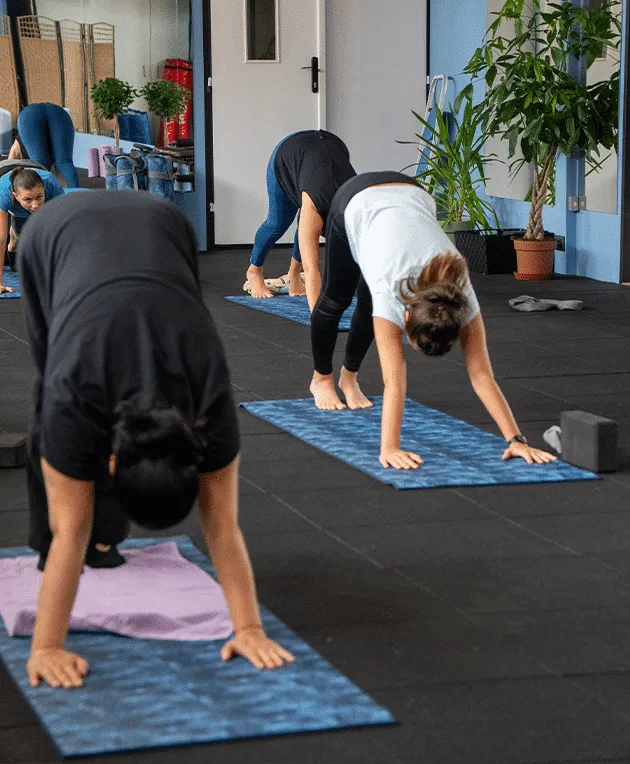
For that, movement really is the answer. Stretching lengthens what has shortened, pilates teaches the deep trunk muscles to work again, and yoga ties the two together with the breath. After a few weeks most people say they had no idea how clenched up they had been living.
We wrote about this separately: which class is right for your back after desk work.
Five signs that mean getting it looked at first
This list is not for diagnosing yourself. It is for recognising when the gym is not the next stop.
- It radiates. Low back pain that travels down the leg, neck trouble that runs into the arm. That is not muscle soreness.
- Numbness or weakness. Your hand goes numb, you drop things, you cannot hold a weight you managed a week ago.
- It hurts at night too. Pain that has nothing to do with load, that shows up at rest, means something different from pain that only appears when you move.
- Swelling or heat. Visible swelling around a joint, or one side that feels warmer than the other.
- You are fresh from an injury or surgery. A sprained ankle, a shoulder injury, knee surgery: there is an order to these things, and training is not the first step.
If any of these is true, it does not mean you have to stop everything. It means get it looked at first by someone who knows.
What physiotherapy and sports rehab actually are
Many people picture physiotherapy as a gentler workout. It is not. The difference is not the intensity, it is what gets examined first.
A training session starts with what your goal is. A physio session starts with what the problem is: where the pain comes from, what moves badly, what is compensating for it. The exercises that come out of that are not good because they are hard, they are good because they answer that specific shortage.
Sports rehab is the continuation: it picks up where pain is no longer the obstacle, but your capacity to take load has not come back yet. That is the stage most people skip, and that is why they get injured again.
The two do not compete, they come in order
Here is what a clean path from a pulled back to normal training looks like:
- Get it looked at. You find out what is wrong, and what is not.
- Physiotherapy. Targeted work on what is actually missing.
- Sports rehab. Rebuilding until you can take load again.
- Training. Gym floor or group classes, now with confidence.
The mistake is always the same: someone starts at step four because it is more comfortable, and three months later they are back where step one should have been.
Who does it here
You do not have to go far for this, and you do not have to go to a stranger.
Szilvi Hajdú teaches stretching and Booty Class here, and works as a physiotherapist at our sister business. Csenge Körömi is a pilates instructor here and a masseuse there. So if it turns out in class that something is not just stiff but actually hurts, the same person can look at it properly, just behind a different door.